Author: StephanieBBlake

I love to help others focus on the one thing that's most important in life through my ministry, teaching and writing. As Vice President of Xtend Ministries International - www.xtendinternational.com, I travel extensively with my husband. I maintain two websites: www.onefocusministries.com and stretchmoney.wordpress.com. On the One Focus site, you can find free Bible studies, devotionals and information about my first book, "The Prayer Driven Life". My book, "Money: How to Be Rich Without It and How to Stretch It Using Ten Hints from the Past and the Technology of Today" was the inspiration for stretchmoney.wordpress.com. Money saving hints are contained throughout the book and this site was created to continue to give helpful hints on stretching money or having the proper view toward money.

The Ministry of Presence

You are near, O Lord, and all Your commandments are truth (Psalm 119:151 NASB).

The Ministry of God’s Presence

Many people envision God (if they think about Him at all) as distant and unapproachable. They may even acknowledge His existence and His creative power but believe He is not involved in the everyday affairs of their lives.

David, a man after God’s own heart, knew this was not true. God’s desire is for an intimate relationship with those who love Him. David loved God. He knew God was near. “The Lord is near to all who call upon Him, to all who call upon Him in truth” (Psalm 145:18 NKJV).

Like David, those of us who also know and love God should be aware of God’s faithful and dependable presence. God’s presence is evident in His creation, His word and the fulfillment of His promises in history. All these reminders lead us to one important truth – what we really need is God.

Without God’s presence, there would be no salvation, no everlasting love, no security, no guidance, no hope, no joy and no peace.

God demonstrated how approachable He is by coming to live among us. Jesus chose to experience the same limitations, temptations and trials we face. At the same time, He showed us by example that we can call on God at any time and He will hear because He is near.

Jesus’ life was truly a ministry of presence – tangible evidence that God is near.

Presence is so important because absence is so painful.

What will make Hell eternally painful is that God will not be there. There will be a day of separation of believers and non-believers. On that day, when He says to those who do not know Him as Savior, “Depart from me,” they will never see or hear from Him again. They will be punished with everlasting destruction and shut out from the presence of the Lord and from the majesty of His power (2 Thessalonians 1:9 NIV).

God is holy and cannot look upon sin. As our substitute, sinless Jesus bore the pain of separation from God the Father upon Himself – for our sakes. His agonizing cry, “My God, My God, why have You forsaken Me?” gives us a glimpse of the suffering and cost of His sacrifice for us. Bearing the hideousness of our sins on His own body on the cross, Jesus experienced the absence of the Father’s presence so that we would not have to.

We need to know He is near. He is. His Spirit is as near as our thoughts, hearts and our breath.

His presence is a gift and a promise – now and forever. Draw near to God and He will draw near to you (James 4:8 NKJV).

Passing on the Ministry of Presence

Sometimes we can serve as Christ’s representative – another tangible evidence of His presence.

My husband and I have an international ministry. We are involved in evangelism, church planting and Christian discipleship training. I have noticed another thing that is as valuable or maybe even more so than our teaching. It is the ministry of presence. Our ministry partners comment on the fact that God has connected us, that we care about them, their families and their ministries and that we have traveled long distances to minister with them. Often there have been periods of discouragement in their lives and our presence – even more than the teaching – has been the thing God has used to keep them going. Our presence is evidence that God cares.

My father went to be with the Lord at age 90. I spent the last few days of his life with him in the hospital. I knew he wanted me to be near him. I didn’t have to say much. In fact, he couldn’t talk to me. He was on a breathing machine. The doctors told me that before I got there, he had been struggling. He had pulled out all the tubes and tried to get out of bed. He tried to fight the doctors. When he saw me, everything changed. He stopped struggling. He relaxed. His daughter that he loved was near him. My presence was what he wanted.

It is not always possible to be physically present to show a loved one you care. As we can serve as God’s representative, He serves as ours. Like many families, there is a geographical distance between my husband and me and our sons and their families. We only get to see them occasionally – once or twice a year. Since we are His children, we count on His presence to convey how much we would love to be with them.

Presence makes a statement of caring. Desertion – deliberate absence – also makes a statement. One of the most chilling words spoken about anyone from the apostle Paul was Demas has forsaken me, having loved this present world (2 Timothy 4:10 NKJV).

——————–

Since I know that God is near, I know that I can talk to Him anytime about anything, no matter where I am. As I learn more about prayer, I am increasingly grateful that He wants to be near and wants to hear from me.

One of Paul’s favorite expressions was “Christ in you.” Jesus’ Spirit is closer to His believers than anyone else can be.

I know the value of feeling my Father’s presence. I talk a lot to God, but I don’t always have something to say. I just feel His presence. I know if He needs to say something to me or I need to say something to him we can talk.

All I really need to know is that He is near.

Fear not, for I am with you; Be not dismayed, for I am your God (Isaiah 41:10a NKJV). “I am with you always, even to the end of the age” (Matthew 28:20b NKJV).

© Stephanie B. Blake

May 2014

Download The Ministry of Presence


Precious Nails

Nails are so common today few people realize how precious they once were. Although I sometimes think a box of nails is expensive, at one time they were valuable enough to be used as a medium of exchange. Until the 18th century nails were made by hand using a very slow process. A fairly common practice during those days was to burn down an old house in order to retrieve the nails. They were that scarce.

In 1794 Thomas Jefferson added a nailmaking operation to his blacksmith shop at Monticello. In 1795, he wrote a letter to Jean Nicolas Demeunier informing him of this new enterprise. “In our private pursuits it is a great advantage that every honest employment is deemed honorable. I am myself a nail-maker…. My new trade of nail-making is to me in this country what an additional title of nobility or the ensigns of a new order are in Europe.”

Jefferson purchased one of the first nail cutting machines in 1796. Several inventors spent large sums of money producing various cutting machines. It has been estimated these men spent over $1,000,000 before a machine made in 1810 was able to produce about 100 nails per minute.

Cut nails are still being used, but after the invention of a wire-nail-making machine in 1851, wire nails are common today because they are so much cheaper. Nails went from being rare and precious to being mass-produced and relatively inexpensive. That fact enables my husband to buy them to build or repair something.

Satan intended the nails that pierced Jesus on the cross to destroy His life, but they were really used to create new life for those of us who trust Him. Jesus took my place on the cross. Through His blood He repaired the relationship between God and man that was marred when sin entered the world (Colossians 1:13-23). Without His allowing those nails to penetrate His innocent hands and feet, I would be facing judgment. Those nails cost Him dearly but it was a price He was willing to pay for my salvation – and yours.

jesus_nails_1Those nails represent God’s sacrificial love and eternal life. They are most precious to me.

As you received Christ Jesus the Lord, so continue to live in him….When you were spiritually dead because of your sins and because you were not free from the power of your sinful self, God made you alive with Christ, and he forgave all our sins. He canceled the debt, which listed all the rules we failed to follow. He took away that record with its rules and nailed it to the cross. God stripped the spiritual rulers and powers of their authority. With the cross, he won the victory and showed the world that they were powerless (Colossians 2:6, 13-15 NCV).

The Culture Mix

Years ago, when my husband and I were driving along the coastline on the island of Oahu, Hawaii we saw a small kiosk on the side of the road called “Pablo Goldstein’s Taco Stand.” For some reason, a man with a Hispanic first name and a Jewish last name selling tacos on the tropical island of Oahu struck me as a little humorous.

941841_10151675158796057_1415540569_nIn many countries where we travel for ministry, we teach among a cultural mix. Several times, I have spoken to women’s groups and asked them how many different nationalities were represented. The results have been as little as three and as many as twenty-something. I am always amazed at how well people with different backgrounds blend together.

Of course, that is not always true. The news and history are filled with stories of cultural clashes. Wars have been fought and borders have been redrawn because of those differences.

After the Second World War, the United Nations was established for the purpose of promoting international co-operation. Hopefully, because of the United Nations, some conflicts have been held in check, but even with 193 member states, cultural conflicts continue throughout the world.

The difference, I believe, in looking past cultural differences and working together or having those differences become a source of conflict is based in one’s attitude toward mankind as governed by a belief system. When I am traveling and teaching, it is among Christians. Christ came to save all men and women.

International groups and churches that I have been a part of certainly have had adjustment issues, but because of Christ, they were usually worked out. Often, the mix of cultures gives an interesting flavor to the worship services. In some churches, for example, the music teams are rotated between different cultural groups.

My life has been greatly enriched by exposure to cultures other than my own.

For God so loved the world that He gave HIs only begotten Son, that whoever believes in Him should not perish but have everlasting life (John 3:16). There is neither Jew nor Greek, there is neither slave nor free, there is neither male nor female; for you are all one in Christ Jesus (Galatians 3:28). Then Peter opened his mouth and said: “In truth I perceive that God shows no partiality. But in every nation whoever fears Him and works righteousness is accepted by Him” (Acts 10:34-35).

April Fools and All Fools

As a child, I remember trying to be aware of the possibility that someone would play a trick on me when April 1 rolled around. I still have to be careful around some people!

April Fools’ day is practiced in many countries. The origin is not certain, but it may have had its beginnings in Iran, where their joking day started as far back as 536 BC.

Scotland has their “Hunt-the-Gowk” Day (“gowk” is Scottish for a cuckoo or foolish person).

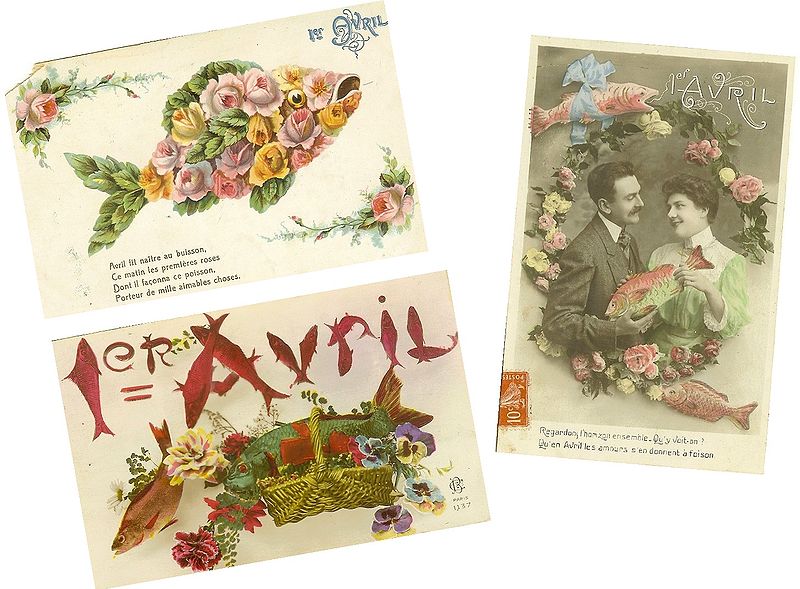
800px-Cartes_postales_poissons_d'avril

“poisons d’avril” postcards.This image (or other media file) is in the public domain because its copyright has expired.

In Italy, France, Belgium, and French-speaking areas of Switzerland and Canada, the tradition on April 1 is to attempt to attach a paper fish to the back of someone else without being noticed. In the late 19th century to the early 20th century April Fish (poisson d’avril) postcards were popular.

Poland avoids serious activities on April 1 – so much so that an anti-Turkish Alliance with Leopold 1, signed on 1 April, 1683 was then back-dated to March 31.

In 1957, the BBC published a fake video of Swiss farmers harvesting fresh-grown spaghetti. They had so many requests for the place to purchase spaghetti plants that they had to admit their prank on April 2.

And the jokes go on and on.

What is no joking matter is being a real fool. Proverbs gives many contrasts between a wise man and a fool, but the most serious charge of all is mentioned twice in the Psalms. I am always aware that we should sit up and pay attention when God says something twice in His word.

The fool has said in his heart, “There is no God.” They are corrupt, they have done abominable works, there is none who does good (Psalm 14:1-3).

The fool has said in his heart, “There is no God.” They are corrupt and have done abominable iniquity; there is none who does good (Psalm 53:1-3).

The commentators mention that there is nothing in the original language to account for “there is” in those two verses. They were added for clarity. If we leave them out, we have “No God.” As H.A. Ironside said,

Let us leave them out: “The fool hath said in his heart, No God” – no God for me, no God in my life, no God in my thinking – I am going to have my own way; I am going to do as I please; I am going to have my fling; I am going to live as I want to live!  “Fools make a mock at sin” (Proverbs 14:9).

April Fools’ Day is also known as All Fools’ Day. All who push God aside in their thinking, whether they don’t believe in Him or know He exists but chose not to obey Him are fools indeed.

Some may think me a fool because I believe in God. I don’t mind.


The foolishness of God is wiser than men…We are fools for Christ’s sake (1 Corinthians 1:25, 4:10)

Download April and All Fools

Big Little Things

Life is full of the little things. The momentous occurs occasionally, but the mundane, the little things, happen every day.

It is the small things that can erode a relationship. Many couples who go in for counseling have a list of small things that have irritated them for years about their spouse. “He always does…” “He never does…” “She always says…” “She never thinks…” “Why can’t he…?” “Why can’t she…?”

Little things add up. If you neglect to take care of yourself each day – no exercise, an undisciplined diet, fail to brush your teeth or take a bath – eventually it will catch up with you. If you do not pick up after yourself, wash your dishes or your clothes, clean your floors, etc., the result could be an uninviting place for you to live and others to visit.

770px-STS-74_crewCol. Chris Hadfield, who wrote An Astronaut’s Guide to Life on Earth, advises one to “sweat the small stuff.” During jet training, he blew a ride. Thankfully, although it was very unusual, the instructor only gave him a warning and did not demand a re-ride (which would have been a black mark on his record). After that incident, Col. Hadfield tried to figure out what had happened. He said the problem was that he had already decided he was a pretty good pilot, good enough that he did not need to fret over every detail. That near re-ride made him rethink his position. He said if you are striving for excellence – there’s no such thing as over-preparation. He said, “In my next line of work, it wasn’t even optional. An astronaut who doesn’t sweat the small stuff is a dead astronaut….It’s all small stuff.”

800px-STS_100_Hadfield_EVADon’t neglect the little things. They can become very big indeed.

Solomon gives an example of how the little things can sneak up on you “like a prowler.”

I went by the field of the lazy man, and by the vineyard of the man devoid of understanding; and there it was, all overgrown with thorns; its surface was covered with nettles; its stone wall was broken down. When I saw it, I considered it well; I looked on it and received instruction; a little sleep, a little slumber, a little folding of the hands to rest; so shall your poverty come like a prowler, and your need like an armed man (Proverbs 24:30-34).

A Friend Indeed

Shipwrecked Prayers

A voyaging ship was wrecked during a storm at sea and only two of the men on it were able to swim to a small, desert like island. The two survivors, not knowing what else to do, agreed that they had no other recourse but to pray to God.

However, to find out whose prayer was more powerful, they agreed to divide the territory between them and stay on opposite sides of the island.

The first thing they prayed for was food. The next morning, the first man saw a fruit-bearing tree on his side of the land, and he was able to eat its fruit. The other man’s parcel of land remained barren.

After a week, the first man was lonely and he decided to pray for a wife. The next day, another ship was wrecked, and the only survivor was a woman who swam to his side of the land. On the other side of the island, there was nothing.

Soon the first man prayed for a house, clothes and more food. The next day, like magic, all of these were given to him. However, the second man still had nothing.

Finally, the first man prayed for a ship, so that he and his wife would leave the island. In the morning, he found a ship docked at his side of the island.

The first man boarded the ship with his wife and decided to leave the second man on the island. He considered the other man unworthy to receive God’s blessings, since none of his prayers had been answered.

As the ship was about to leave, the first man heard a voice from heaven booming, “Why are you leaving your companion on the island?”

“My blessings are mine alone, since I was the one who prayed for them,” the first man answered. “His prayers were all unanswered and so he does not deserve anything.”

“You are mistaken!” the voice rebuked him. “He had only one prayer, which I answered. If not for that, you would not have received any of my blessings.”

“Tell me,” the first man asked the voice, “What did he pray for that I should owe him anything?”

“He prayed that all your prayers be answered.”

For all we know, our blessings are not the fruits of our prayers alone, but those of another praying for us.

My prayer for you today is that all your prayers are answered.

– Author unknown (I searched for the author of this story, and every reference said “author unknown.”  If anyone knows the author, please let me know).

Friends of God

God created us for fellowship.  We need each other. We need friends.  Our best example in any relationship is Jesus.  His last days before His crucifixion were spent trying to prepare His friends for His departure.  The discourse begins in John 13 but He was especially tender when He addressed His closest friends in the middle of chapter 15.  In John 15:9-17, what we hear Jesus saying is “I chose you as My friends and now I am going to die for you.  If you love Me, you will obey Me by loving one another.”  Both verses 12 and 17 put love for our friends in the form of a commandment.  Verse 13 says that our friendship is measured by our willingness to sacrifice.

Friends were important to Jesus. He sought friends, dined with friends (was accused of being friends with sinners), visited friends (Mary, Martha and Lazarus) and ultimately died for His friends.  If our Lord needed friends, how much more do we need them?

Other Biblical Examples of Friendship

Paul and Timothy

In 2 Timothy, we find Paul’s last words to his dear friend Timothy. Although Paul asked Timothy to visit several times in this letter, we have no evidence that he ever saw Timothy again. In fact, Paul seemed to be aware that his death was imminent. Scholars believe that he died shortly after this letter was written.  These were possibly his last written words.  Knowing that his time was short, Paul took the time to write to Timothy.  He had many things he needed to say.  In this letter (as in the previous one), Paul instructed his friend, encouraged him, and let him know how important Timothy was to Paul and to Kingdom work.

Just as Jesus promised to send the Holy Spirit to counsel and stand alongside of us, Paul demonstrated that those are the characteristics of a true friend. Just observe the tender references that Paul had for Timothy.

  • The greeting to Timothy, my dear son (1:2)
  • Timothy, I thank God for you (1:3).
  • I long to see you (1:4).
  • Words of encouragement in 1:5-8.
  • Words on instruction in 1:9-12.
  • Encouragement to follow Paul’s example (2:1-3).
  • Warned his friend of danger (3:1)
  • Reminded Timothy to remain faithful (3:14)
  • Don’t be afraid. Finish the work (4:5).
  • Come to see me (4:9).
  • Asked for a special favor. Bring my coat, books and papers (4:13).
  • Hurry! (4:21). It’s as if Paul said, “I really need you. Hurry!”

Paul’s last words were full of praise for other friends as well:

  • Onesiphorus (1:16-18)
  • Luke (4:11)
  • Prisca and Aquila and the household of Onesiphorus (4:19)
  • Erastus, Trophimus, Eubulus, Pudens, Linus, Claudia and other brethren (4:20-21)

He also expressed deep sorrow at those who had proven not to be his friends:

–       Phygellus, Hermogenes, Hymenaeus, Philetus (1:15, 2:17-18)

–       Demas (4:10)

–       Alexander the coppersmith (4:14)

Other Examples

We find many other examples of friends in the Bible:

  • David and Jonathan: 1 Samuel 18:1-4, 20:17
  • Daniel and his three companions: Daniel 2:49
  • Mary, Martha, Lazarus and Jesus: Luke 10:38-42, John 11:1-46
  • Paul, Timothy and Epaphroditus: Philippians 2:19, 20, 22, 25
  • Paul, Priscilla and Aquila: Romans 16:3, 4
  • The apostle John: 3 John is filled with mention of several friends and John’s love for them (as well as a sad description of one who was not a friend).
  • Many others

Questions for reflection:

  • What other Biblical examples of friendship have you noted?
  • What have you learned from these examples?
  • Are you in a mentoring relationship?  Paul taught Timothy many things, but it was also evident that Timothy’s friendship brought much value to Paul’s life.  As a mother of adult sons, I have learned much from their wisdom.  Can you see the value of this special relationship for both the person being mentored and the mentor?

Guidelines for Friendships

ŸBe God’s friend first (James 2:23, 4:4).

ŸAfter God, your spouse (if you have one) should be your best friend. Husbands and wives have a very special relationship (Ephesians 5:21-33).

ŸAsk God whom He wants you to befriend (Matthew 11:19).

Choose wisely, but know that He wants you to befriend both believers and unbelievers. How will unbelievers become believers if we don’t love them into the Kingdom of God?  One caution in such a relationship is to be strong enough in your Christian walk that the unbeliever cannot influence you to do worldly things.  If a relationship tends to bring you down, and you are not able to be strong and help the other person up, then it may be best to dissolve the relationship.

This is true especially among young people who are so easily influenced.  There is also a special caution in the dating arena.  One youth pastor I know tells his young people, “never date someone whom you would not consider a worthy candidate as a spouse.”

However, I think that some Christians err on the other side as well and determine never to become friends with anyone who is not a Christian.  That is definitely not a Biblical standard.  Your best friends will probably be Christians, but if you have an evangelistic heart, God will lead you to befriend those who need to know Him. Of course, Jesus was a friend of sinners and we should be, too.  However, we should recognize the limitations of that relationship.

The godly give good advice to their friends; the wicked lead them astray

(Proverbs 12:26 NLT).

Questions for reflection:

  • Have you considered the Biblical guidelines for friendship?
  • Have you ever had a friendship that was destructive?  If you are still in that friendship, what should you do about it?
  • How do you think making God your top priority in life affects the relationship you have with your friends?
  • In John 13:15, Jesus said that we should follow his example.  What does this tell you about your attitude toward your friends?

Choosing Friends Wisely

Ÿ  Do not associate with a man given to anger; or go with a hot-tempered man, lest you learn his ways, and find a snare for yourself (Proverbs 22:24 NASB). Choose someone who is not easily angered.

Ÿ  Do not eat the bread of a selfish man, or desire his delicacies, for as he thinks within himself, so he is (Proverbs 23:6 NASB).  Choose someone who is not selfish or stingy.

Ÿ  He who walks with wise men will be wise, but the companion of fools will suffer harm (Proverbs 13:20 NASB). Leave the presence of a fool, or you will not discern words of knowledge (Proverbs 14:7 NASB). Do not speak in the hearing of a fool, for he will despise the wisdom of your words (Proverbs 23:9 NASB). Choose someone who is not foolish.

Ÿ  Do not be envious of evil men, nor desire to be with them; for their minds devise violence, and their lips talk of trouble (Proverbs 24:1 NASB). How blessed is the man who does not walk in the counsel of the wicked, nor stand in the path of sinners, nor sits in the seat of scoffers! (Psalms 1:1 NASB). Choose someone who is not evil.

Ÿ  Now we command you, brethren, in the name of our Lord Jesus Christ, that you keep aloof from every brother who leads an unruly life and not according to the tradition which you received from us (2 Thessalonians 3:6 NASB). Choose someone who is not unruly or disorderly.

Ÿ  He who goes about as a slanderer reveals secrets. Therefore do not associate with a gossip (Proverbs 20:19 NASB).  Choose someone who is not a gossip.

Ÿ  Do not be with heavy drinkers of wine, or with gluttonous eaters of meat; for the heavy drinker and the glutton will come to poverty, and drowsiness will clothe a man with rags (Proverbs 23:20-21 NASB).  Choose someone without serious addictions.

Ÿ  It is better to live in a corner of a roof, than in a house shared with a contentious woman. . . . It is better to live in a desert land, than with a contentious and vexing woman (Proverbs 21:9, 19 NASB).  Men (and women), choose your spouse carefully.

Ÿ  This command I entrust to you, Timothy, my son, in accordance with the prophecies previously made concerning you, that by them you may fight the good fight, keeping faith and a good conscience, which some have rejected and suffered shipwreck in regard to their faith.  Among these are Hymenaeus and Alexander, whom I have delivered over to Satan, so that they may be taught not to blaspheme (1 Timothy 1:20 NASB). Even among Christian brothers, there is a limit.

Ÿ  But be forgiving. But if any has caused sorrow, he has caused sorrow not to me, but in some degree . . . to all of you. Sufficient for such a one is this punishment which was inflicted by the majority, so that on the contrary you should rather forgive and comfort him, lest somehow such a one be overwhelmed by excessive sorrow.  Wherefore I urge you to reaffirm your love for him (2 Corinthians 2:5-11 NASB). For if you forgive men for their transgressions, your heavenly Father will also forgive you (Matthew 6:14 NASB).

Ÿ  Satan will try to divide the people of God. See 1 Corinthians 1:10, 1 Corinthians 5:1-6.

Questions for reflection:

  • How important is it for you to choose your friends wisely?
  • In the verses above, what catches your attention?  Are there some principles here that you have not thought of before?

Special Christian Friendships

            There is a special friendship/kinship among believers, but even in the family of God, you should choose your friends wisely.

Ÿ  I am a companion of all those who fear You, and of those who keep Your precepts (Psalm 119:63 NKJV).

Ÿ  Then those who feared the Lord spoke to one another, and the Lord listened and heard them, so a book of remembrance was written before Him for those who fear the Lord and who meditate on His name (Malachi 3:16 NKJV).

Ÿ  And they continued steadfastly in the apostles’ doctrine and fellowship, in the breaking of bread and in prayers (Acts 2:42 NKJV).

Ÿ  I thank my God upon every remembrance of you, always in every prayer of mine making request for you all with joy, for your fellowship in the gospel from the first day until now (Philippians 1:3-5 NKJV).

Ÿ  . . . but if we walk in the light as He is in the light, we have fellowship with one another, and the blood of Jesus His Son cleanses us from all sin (I John 1:7 NKJV).

Questions for reflection:

  • It has been said that you are known by the company you keep.  How do you respond to that statement?
  • Are your friends helping you mature in your Christian faith?  Do they tend to hold you back?
  • Reflect on the Christian friends who have helped you grow in your relationship to God.  Does someone stand out?
  • Do you allow your Christian friends the opportunity to correct your behavior if needed? Do you have an “accountability partner”?
  • Do you remember to thank God for those special friends? In what ways can you show your gratitude?

Characteristics of A Friend

  1. Loves (Proverbs 17:17; 1 Corinthians 13)
  2. Prays (2 Thessalonians 3:1-2)
  3. Is a giver, not always a receiver (Proverbs 18:24)

I went out to find a friend. But could not find one there. I went out to be a friend. And friends were everywhere! ~ Author unknown.

  1. Gives godly counsel (Proverbs 27:9)

A friend is… a push when you’re stopped – a word when you’re lonely – a guide when you’re searching – a smile when you’re sad – a song when you’re glad!

~ Author unknown.

  1. Is consistent (Proverbs 27:10)
  2. Is interested in your growth (Proverbs 27:17)
  3. Stays by your side (Ecclesiastes 4:9-12). Do two men walk together unless they have made an appointment? (Amos 3:3).  The North American Indian describes a friend as “one-who-carries-my-sorrows-on-his-back.”

Questions for reflection:

  • Are these characteristics true of you?
  • Can you think of one or more of your friends who embody these characteristics?
  • What difference does it make in your life to have a friend like this?

________________________________________________________________________

An English publication offered a prize for the best definition of a friend, and among the thousands of answers received were the following:

–       “One who multiplies joys, divides grief.”

–       “One who understands our silence.”

–       “A volume of sympathy bound in cloth.”

–       “A watch which beats true for all time and never runs down.”

–       But here is the best definition that won the prize: “A friend – the one who comes in when the whole world has gone out.”

 “Only God Gives a Friend” by Rosalie Carter

I think that God will never send,

A gift so precious as a friend.

A friend who always understands,

And fills each need as it demands.

Whose loyalty will stand the test.

When skies are bright or overcast.

Who sees the faults that merit blame,

But keeps on loving just the same

Who does far more than creeds could do,

To make us good, to make us true,

Earth’s gifts a sweet contentment lend,

But only God can give a friend!

Questions for Reflection:

  • Describe your best friend. Why is she so special to you?
  • Can you recall a time when you made it through a really tough circumstance because of the care of a friend? If so, did you ever say “thank you?”
  • Do you have friends that pray faithfully for you?
  • Do you pray faithfully for your own friends?
  • What are some ways that you can grow as a friend?
  • What are some ways that you can let your friends know how valuable they are to you?
  • Reflect again on what Jesus had to say to his friends before he died. This is My commandment, that you love one another as I have loved you. Greater love has no one than this, than to lay down one’s life for his friends. You are my friends if you do whatever I command you.  No longer do I call you servants, for a servant does not know what his master is doing; but I have called you friends, for all things that I heard from My Father I have made known to you  (John 15:12-15 NKJV).
  • What does it mean to you to be a friend of Jesus? What can you learn from his example as a friend? Have you ever thought of him in this role?  John 15:13 tells us how important that role was to Jesus.

© Stephanie B. Blake

Download A Friend Indeed

AAA Marriage

AAA Marriage

“And you shall love the Lord your God with all your heart, with all your soul, with all your mind, and with all your strength.” This is the first commandment.  And the second, like it, is this: “You shall love your neighbor as yourself” (Mark 12:28-31).

There is no more important relationship than the one you have with God. However, if you are married, your spouse is your most important human relationship. He/she is your closest neighbor. Wedlock has the potential of not only being the most joyful and fulfilling relationship, but also the most difficult. What a person imagines marriage will be like and what marriage is actually like can be two different things.  Even the best marriages have trials and tribulations.

The difficulty of the relationship is evident by the divorce rate. Statistics indicate that the divorce rate among second and third marriages is even higher than first marriages. So, swapping spouse number one for spouse number two or three has not proven to be the solution to the problem.

Marriage counselors make a living trying to keep marriages together. Priests, preachers and church leaders are often called upon to comfort and guide husbands and wives. Many spouses have given it everything they had, but because their partners did not, the marriages did not make it. It is possible to bounce back from a dissolved marriage with God’s help, but few have entered marriage with the idea that it would not work out.

Although marriage is part of God’s design, it is not God’s plan for every person. Some individuals are called to live singly. Paul addresses that issue in 1 Corinthians 7.

This study is addressed to a specific group of married people – men and women who are both Christians striving to glorify God in their lives and their marriages. They realize there are spiritual standards that apply to them. What are those standards and how can a Christian couple apply them to daily living?

In school, teachers have a standard: a letter grade that is evidence of the student’s achievements.  Top students earn an A, while students who have perfect scores rate an A+. Superior businesses are given AAA rating. With few exceptions, students who achieve an A or A+ and businesses that have a AAA rating do so with a great deal of work, dedication and sacrifice. They believe excellence is worth the effort.

Being willing to apply Biblical principles and to put the other person first, Christians should be dedicated to the personal sacrifice that makes their marriage work – Accept, Adapt and Aim –  AAA marriage.

ACCEPT

It is true that opposites attract.  Very few couples are like in temperaments. Complications come with that attraction, however, because different ways of doing things and opposite views can result in friction.  In the courting stage, couples often see the other person as “completing” him/her.  That sometimes means the strengths of one person are contrary to the strengths of the other.  It actually may be a weakness of the other person.

A good example is neatness or orderliness.  One spouse is often a very organized person while the other is a bit sloppy.  You get the picture. That can lead to some interesting situations.

Some people erroneously believe they can change their spouse after marriage.  People do change as they grow older, but expecting a certain change in someone leads to inevitable disappointment. Even as we grow, our temperaments remain the same. An introverted child remains introverted as an adult and an extroverted child remains extroverted as an adult.  The difference comes in learning to harness the strengths of a temperament and control the weaknesses.  However, only an individual can do this for himself. No one else can do it for him.

Men and women think differently and react differently to circumstances.  This results in a gender culture shock after marriage.  Other cultural differences such as race, nationality, age and faith can further complicate the relationship. Differences that are so attractive before marriage often become conflict after marriage.

Once a person plans to marry or is married, the first “A” is to accept his partner just the way she is.  Different is not necessarily wrong – it is often just another point of view – distinct from the other person’s.  Different is often just . . . different.

Accepting another person is only possible if one has a proper view of oneself.  In order to accept someone else, you have to accept yourself. Sometime that takes more work than accepting your spouse. Examine the wording of Mark 12:28-31. Jesus said that you should love your neighbor as you love yourself.

ADAPT

Adjustments are necessary in the marriage relationship.  You must adapt to the differences you have accepted in the other person. The primary adjustment is the relationship itself: Therefore a man shall leave his father and mother and be joined to his wife, and they shall become one flesh (Genesis 2:24).

Both Paul and Peter, apostles of Jesus, had important things to say about the roles of a husband and wife. Adapting to these roles takes a lot of work for both parties.

After the apostle Paul instructed believers to walk in love . . . be filled with the Spirit . . . and [submit] to one another in the fear of God (Ephesians 5:2, 18, 21), he addressed marriage partners. Knowing that adaption is a hard process, the Bible has some specific helps about how to make the adjustment.

Scripture and Questions for Reflection:

Wives, submit to your own husbands, as to the Lord. For the husband is head of the wife, as also Christ is head of the church; and He is the Savior of the body.  Therefore, just as the church is subject to Christ, so let the wives be to their own husbands in everything (Ephesians 5:22-24).

  • These verses have been misinterpreted, misunderstood and avoided.  There is no indication here or elsewhere in Scripture, of women being inferior.  Do these verses state that women are to be subject to men? See verse 21.
  • A hierarchy exists in business with the President being followed by a Vice President, etc.  Opinions of other leadership figures are often consulted, but the responsibility for a decision lies with the President.  There cannot be two Presidents.  Nothing would ever be decided on. Is there a correlation between the roles of husband and wife and President/Vice President?
  • Every Christian is to be subject to Christ.  Paul here states that the wife’s submission to her husband is similar to their submission to the Lord.  It has been said that where there is no responsibility, there is no accountability. If a decision is made according to these standards and it is wrong, who is responsible?
  • Compare 1 Peter 3:1-6 with these verses in Ephesians.

Husbands, love your wives, just as Christ also loved the church and gave Himself for her, that He might sanctify and cleanse her with the washing of water by the word, that He might present her to Himself a glorious church, not having spot or wrinkle or any such thing, but that she should be holy and without blemish (Ephesians 5:25-27).

  • Christ died for His Bride, the Church. What is the standard that Christ sets for the role of the husband?

So husbands ought to love their own wives as their own bodies; he who loves his wife loves himself. For no one ever hated his own flesh, but nourishes and cherishes it, just as the Lord does the church (Ephesians 5:28-29).

  • How does these verses relate to Mark 12:28-31?

This is a great mystery, but I speak concerning Christ and the church. Nevertheless let each one of you in particular so love his own wife as himself, and let the wife see that she respects her husband  (Ephesians 5:32-33).

  • What does a woman generally want most from her husband?
  • How does respect express a wife’s love for her husband?
  • Compare Ephesians 5:25-33 with 1 Peter 3:7.  What does Scripture say can hinder the prayers of a man?

How can spouses accept each other’s differences and adapt to them? Scripture gives the criteria for true love: Love is patient and kind. Love is not jealous or boastful or proud or rude. Love does not demand its own way. Love is not irritable, and it keeps no record of when it has been wronged.  It is never glad about injustice but rejoices whenever the truth wins out. Love never gives up, never loses faith, is always hopeful, and endures through every circumstance (1 Corinthians 13:4-7 NLT).

  • Often it is the little things of life that cause constant irritation in a couple’s relationship.  Have you ever known a spouse who “kept a record of wrongs” and was ready to relate it at any moment?
  • Do you need to change anything in order to apply this standard of love to your marriage relationship?

AIM

Let us be glad and rejoice and give Him glory, for the marriage of the Lamb has come, and His wife has made herself ready. And to her it was granted to be arrayed in fine  linen, clean and bright, for the fine linen is the righteous acts of the saints (Revelation 19:7-8).

Remembering that this study is structured for Christians, it is easy to understand that the AIM of a Christian marriage is to put Christ first.  If a Christian understands and accepts God’s love for her in her own life, she will be able to love her spouse with a greater love than a non-believer. The Bible has a lot to say about marriage on earth and in heaven.  From Genesis to Revelation, marriage is mentioned, sometimes in context of an earthly marriage, but many times with a future spiritual application.

Examine the following passages with the thought that marriage on earth is preparation for marriage of eternity.

  • The Lamb in Revelation is Jesus.  Compare Revelation 19:7-8 with Ephesians 5:25-27 and reflect on the husband’s role in marriage.
  • Believers are recorded in the Lamb’s Book of Life.  They are the only ones who will be with Jesus, the Bridegroom, for eternity. See Revelation 3:5. What is the symbolism of the Holy City, the New Jerusalem (Revelation 21:2, 9-10) and who gets to enter there (21:27)?
  • Read Jesus’ parable of the wedding feast in Matthew 22:1-14. The king in the parable cast out the person who did not have the proper wedding garment (11-14).  Compare this parable to Revelation 3:5 and 21:27. Who wears the proper wedding garment to the wedding and what color is it?
  • No one has really been pure except Christ. How can His Bride come to the wedding feast with a white garment? See Revelation 7:14.

Life on earth is preparation for life eternally.  Paul tells believers to set your mind on things above, not on things on the earth (Colossians 3:2) and whatever you do in word or deed, do all in the name of the Lord Jesus, giving thanks to God the Father through Him (Colossians 3:17).  Further on in that chapter, he repeats whatever you do, do it heartily, as to the Lord and not to men, knowing from the Lord you will receive the reward of the inheritance; for you serve the Lord Christ (Colossians 3:23-24).  Wedged in between verses 17 and 23, he again addresses believers who are in a marriage relationship.

Believers are to be holy, set apart, from those who do not believe. They are to put on tender mercies, kindness, humility, meekness, longsuffering; bearing with one another, and forgiving one another, if anyone has a complaint against another; even as Christ forgave you, so you also must do (Colossians 3:12-13). The primary goal or aim of Christ’s life was to bring people to God through His sacrificial love. As He served, He asks His followers to serve (John 13:1-17), stating “A servant is not greater than his master, nor is he who is sent greater than he who sent him. If you know these things, blessed are you if you do them.” 

Christians can know [the] things [that honor God in a marriage]. Blessed are you if you do them. The world is watching closely for evidence that faith in God makes a difference in a marriage relationship.

© Stephanie B. Blake

Unless otherwise noted, all Scripture quotations are from the New King James Version. Copyright © 1982 by Thomas Nelson, Inc. Used by permission.  All rights reserved.

Download AAA Marriage

Ancient Wisdom

As a study of the book of Proverbs, he next three Bible studies are designed to go together.

Ancient Wisdom for Today: Reliable Advice

Ancient Wisdom for Today: Relating to God

Ancient Wisdom for Today: Relating to Others

Ancient Wisdom for Today: Reliable Advice

In the second half of the 20th century, there were two very popular newspaper advice columns. Ask Ann Landers lasted the longest. Using the fictional pen name of Ann Landers, Ruth Crowley started writing the column in 1943. It was picked up by Eppie Lederer in 1955 and lasted until 2002. Eppie’s twin sister, Pauline Phillips, introduced Dear Abby in 1955. That column ran until 1995.

Readers of these columns were so loyal they continued to ask newspapers to run the columns even after the writers had retired. The archives of these advice columnists can be found online. Query quotes from these columnists and you will find many.

These ladies may have done considerable research in order to respond to the letters they received, but in the end, the advice they gave was personal opinion. Some of the advice resulted in controversy and an occasional loss of a sponsoring newspaper. The clamor for continued columns, however, reveals that people are looking for answers to life’s issues and a credible source for those answers.

The only reliable source of guidance lies in the one place where advice is totally trustworthy – God’s word. An online search of the word proverb will reveal excerpts from the Bible accredited as a societal proverb. Some people are not even aware they are quoting from scripture. Although all of scripture has relevancy to how a person lives, perhaps the most quoted portion of the Bible is Proverbs.

Perhaps this is true because most societies have their own proverbs – short sayings that contain some traditionally held belief. The Touchpoint Bible notes that a biblical proverb is

not a law of God (which must be followed) or a promise of God (which guarantees a certain result). A proverb is a general principle that, if followed, applies to most people in most situations. While the desired result may not always occur in your life, the course of action suggested in the proverb is always the right thing to do.

The key to understanding the difference between a proverb of a people and the proverbs of the Bible are “traditionally held” beliefs. Noted above, a biblical proverb suggests a course of action that is always the right thing to do. In a societal proverb, the principles are traditional, but not necessarily correct – such as a watched pot never boils; all’s fair in love and war and children should be seen and not heard. Some people even believe they are quoting scripture when they are actually quoting a traditional saying, such as God helps those who help themselves.

And God gave Solomon wisdom and exceedingly great understanding…He spoke three thousand proverbs, and his songs were one thousand and five (1 Kings 4:29, 32).

Known as the wisest man that ever lived, King Solomon wrote most of the book of Proverbs – around eight hundred of them. Before he became king, God told him He would grant any wish he had. Solomon asked for wisdom to rule God’s people. Not only was he known for his wisdom and his more than three thousand proverbs, there was also total peace during his reign.

Solomon did not always take his own advice. He did not stay true to his own promise to be wholly devoted to the Lord (he allowed his many wives to lead him into idolatry) and his reign ended the golden days of Israel. After his death, the kingdom was divided and the glory days were over.

Nevertheless, Solomon’s proverbs were inspired by God. His proverbs and those of the others who contributed to the biblical book of Proverbs still lead us to contrast the differences between wise people and foolish people. The principles contained in the proverbs apply to every area of life – political, ethical, business, familial and personal. God centered wisdom is the best source for advice.

Although Proverbs is not a book of manners, it has a great deal to say about how to be gracious in your speech and your actions dealing with all relationships: strangers, neighbors, friends and family.

Proverbs deals with aspects of a person’s relationship to God and others. Many themes are scattered throughout the book. In a detailed search of my own, eight common themes were discovered. Four themes relate to our vertical relationship to God and four others pertain to our horizontal relationships with others.

  • The Wise Person Fears God
  • The Wise Person Strives to Understand
  • The Wise Person Obeys the Commandments
  • The Wise Person Accepts Discipline
  • The Wise Person Stands Upright
  • The Wise Person Watches His Words
  • The Wise Person Cares for Others
  • The Wise Person Works but Leaves the Results to God

Answers to life’s questions are found in God’s word. A reliable source for advice can be found in Proverbs.

© Stephanie B. Blake

Download Ancient Wisdom for Today-Reliable Advice


Ancient Wisdom for Today: Relating to God

The Wise Person Fears God 

The fear of the Lord is the beginning of wisdom (Proverbs 1:7).

The word fear has two very distinct definitions. The most common use is that of anxious concern or dread – being afraid. The other is to venerate – to have reverential awe.

These two forms of the word fear occur throughout the Bible and frequently in the book of Proverbs. The foundational principle for Proverbs is the fear of God. Proverbs 1:1-6 tells why the book was written. The next verse describes how all wisdom begins – with the fear of God.

Although God deserves our reverential awe, disrespect toward Him abounds. As if He is on call to do our bidding and supply our every desire, He is often referred to as the Man Upstairs or the Great Father in the Sky. Worse still, His name often comes in front of a curse word.

A.W. Tozer, who wrote The Knowledge of the Holy, states, “the essence of idolatry is the entertainment of thoughts that are unworthy of Him.”

Anyone visiting the President of the United States, the Queen of England or any other national head of state would first be taught the proper protocol to exercise while in their presence. This would include how to dress, what to say and what not to say. No one would expect otherwise.

Yet many argue that God’s protocol is unjust. Anyone wanting to stand in His presence must come with clean hands and a pure heart – obtained only through Jesus Christ. In His parable of the wedding feast, the man without the proper wedding garment was cast away into darkness. Access to God came at a high price – the price of His Son. Jesus provided the pure white garments for us.

God knows our hearts and whether we respect Him. By those who come near Me I will be treated as holy and before all the people I will be honored (Leviticus 10:3 NAS).

The wonder of a proper fear of God is that it results in removing fear of everything else. If you fear God, you need fear nothing else. John Newton, who wrote Amazing Grace, put it this way, “’Twas grace that taught my heart to fear, and grace my fears relieved.”

For further study:

Underline “fear of the Lord” throughout Proverbs and discuss the verses.

Compare the two types of fear in the following verses: Psalm 27:1, Proverbs 3:24, Philippians 4:6-7, 1 Peter 5:7, 1 John 4:1

The Wise Person Strives to Understand 

The knowledge of the Holy is understanding (Proverbs 9:10).

Knowledge without understanding is like a car without gas. The possibility is great, but the missing element is essential.

At some point in every person’s life, there are questions to be answered. Who is God? Who am I? What is the purpose of my life?

The wisdom book of Proverbs states its purpose from the very beginning. In the first six verses of chapter one, the word understanding appears three times. There are only five chapters in the book (Proverbs has thirty one chapters) where understand or understanding does not appear. In the chapters where it does appear, many have multiple entries.

Understand or understanding is used either in the positive as a wise person who understands or the negative as in a foolish person who lacks understanding. It is clear that it takes work to understand life. The easy, lazy way of life leads to a lack of understanding.

Ordinarily, we associate understanding with our mind – our intellectual discernment. However, God examines our hearts, knows our hearts and judges our hearts. In the Bible, the heart is equal to the seat of our emotions, our inner being, who we really are. Often in Proverbs, the wise person is instructed to apply your heart to understanding. If our understanding were only intellectual, we might not apply the principles we have learned for service.

In order to answer the questions of life, we must get to know the one who created us. We need to get to know God. There is no one like Him.

There are some excellent resources to help us understand the nature of God and His attributes. My favorites are The Knowledge of the Holy by A.W. Tozer and Knowing God by J. I. Packer.

The primary source is God’s Word itself. Tozer advises us to throw away every comparison word like trait, characteristic or quality when we think of God. We cannot know everything about God, but we can discover those things He has chosen to reveal about Himself. Then, and only then, can we answer the questions, “Who am I” and “What is my purpose?” Those answers are tied to who God is, what He has done for us and what His plan is.

For further study highlight every time “understand” or “understanding” appears in Proverbs discussing the positive and negative implications.

The Wise Person Obeys God 

“Do not think that I came to destroy the Law or the Prophets. I did not come to destroy but to fulfill” (Matthew 5:17).

One of the first words most children learn is “no.” Human nature resists rules. For his own good, however, parents need to set limits for their child. Playing in the fenced yard is OK. Playing in the street is not.

A parent’s responsibility is to help God mold the character of his child. A compassionate parent is also one that is in control. Even when a child does not yet understand the rules set by his parents (never touch a stovetop, don’t run with scissors), he should be confident that there is good reason for them.

The child can trust his father to know what is best.  Rules are boundaries for character development and protection.

Laws in society are similarly put in place for protection. When they are no longer in place, human nature often takes over with disastrous results. The aftermath of Hurricane Katrina in New Orleans gave us a glimpse of what that was like.

Jesus is the only human being who obeyed His Father’s commandments completely. He willingly submitted Himself to our human limitations. As a Man, He learned obedience (Hebrews 5:8) and set an example for us.

His perfect life and sacrificial death released us from the bondage of the law. The law itself is good, but since we are incapable of obeying it perfectly, it was a bondage to us. Jesus’ gift of grace made reconciliation to God possible.

As Christians, we should trust God. We see in His laws His hand of guidance and protection. Jesus fulfilled the law for us and summarized all that it represented in His new commandment to love one another as He loves us.

Believers are to be in submission, not under bondage. There is a difference. We are free in Christ. Submission is voluntary. Bondage is not.

We should look at the commandments of God like a child views the instruction of his parents. The boundaries and guidelines are for our protection and our growth.

For further study, highlight all the passages in Proverbs concerning law and commandments. Compare the Ten Commandments (Exodus 20) with these passages in Proverbs. Examine how disobeying the commandments can harm your Christian life and witness.

For the law of the Spirit of life in Christ Jesus has made me free from the law of sin and death (Romans 8:2)

The Wise Person Accepts Discipline 

For whom the Lord loves He corrects, just as a father the son in whom he delights (Proverbs 3:12).

Discipline and punishment are often used interchangeably, but they are not the same. When someone sees a child acting rudely in a public place, you might hear her say, “I wish his parents would discipline that child.” What she often means is that she expects the parent to punish them for their bad behavior.

Punishment carries the idea of inflecting a penalty for an offense. Discipline is training someone to obey a code of behavior. Discipline may include a spanking after an infraction if that is needed, but never with the intent of harm or with anger. Correction and instruction are the goals. Depending on the child’s personality, a conversation about the offense or removal from the store may have the same effect as a spanking would for another child.

The root of discipline is also the word for a follower of Christ: disciple. Aids to spiritual growth are often called spiritual disciplines. Discipline is the voluntary mental and active submission to God’s will. A disciplined Christian can disciple other believers.

Richard Foster, author of Celebration of Discipline, the Path to Spiritual Growth says, “The classical disciplines of the spiritual life call us to move beyond surface living into the depths.” He lists spiritual disciplines as: inward disciplines (meditation, prayer, fasting, study); outward disciplines (simplicity, solitude, submission, service) and corporate disciplines (confession, worship, guidance, celebration). He carefully warns against turning any spiritual discipline into law.

Spiritual discipline is connected with the idea of guidance and correction. Just as a loving father corrects his child in order for him to develop a good character, God lovingly guides, corrects and instructs, knowing that when one of his children has willingly received his correction, he is able to help others.

The disciplined believer is:

  • Loved of God (Proverbs 3:11-12, 13-13).
  • Living according to God’s standards (Proverbs 6:20-23).
  • Listening to God speak (Proverbs 1:1-7; 13:1; 15:5, 31; 25:12)
  • Learning every day (Proverbs 9:8-9; 10:8; 12:1; 13:18; 15:32; 25:12)
  • Leading others to do the same. Patiently correct, rebuke, and encourage your people with good teaching (2 Timothy 4:2 NLT).

Hear counsel, receive instruction, and accept correction that you may be wise in the time to come (Proverbs 19:20 Amplified).

© Stephanie B. Blake

Download Ancient Wisdom for Today-Relating to God