Author: StephanieBBlake

I love to help others focus on the one thing that's most important in life through my ministry, teaching and writing. As Vice President of Xtend Ministries International - www.xtendinternational.com, I travel extensively with my husband. I maintain two websites: www.onefocusministries.com and stretchmoney.wordpress.com. On the One Focus site, you can find free Bible studies, devotionals and information about my first book, "The Prayer Driven Life". My book, "Money: How to Be Rich Without It and How to Stretch It Using Ten Hints from the Past and the Technology of Today" was the inspiration for stretchmoney.wordpress.com. Money saving hints are contained throughout the book and this site was created to continue to give helpful hints on stretching money or having the proper view toward money.

Challenges of Past and Uncertainty of Tomorrow Fuel Actions of Today

I recently became aware of a very courageous young man, Lt. Col. Gregory Gadson. In May 2007, he lost both legs when his vehicle passed a roadside bomb in Baghdad. As he dealt with his injuries, he thought his future looked bleak, but he decided not to give up. His grit and determination landed him in the public eye – with positive results.

Assistant coach Mike Sullivan of the New York Giants invited Lt. Col. Gadson to a game. From his wheelchair, Lt. Col. Gadson delivered a pregame speech to the team. Although the Giants had lost their first two outings that year, they went on to win that game – and the 2008 Superbowl.

Lt. Col. Gadson played the part of a double amputee in the movie Battleship. Not only did he take the challenge, but to the amazement of everyone around him, performed his own stunts.

Lt. Col. Gadson considers his primary role to be that of Director of the Army’s Wounded Warrior program, saying, “As a service member, there are a lot of people who have endured what I have, but their paths won’t be highlighted. I want to speak up for them. I know we’re not promised tomorrow. But there is a road ahead.”

Lt. Col. Gadson reminded me of Franklin D. Roosevelt who served as President of the United States from a wheelchair. The limited use of his body did not slow him down nor did it affect his leadership abilities. Certainly mobility adds to enjoyment of life, but it is not life itself. That has been proven daily by many who have limited use or no use of their bodies.

Lt. Col. Gadson is just one of many brave men and women who have fought in our wars and lost their limbs. Others, like him, have demonstrated that their courage was not just in the field of war, but also in the choices they made to continue to live life to the fullest and to contribute to society.
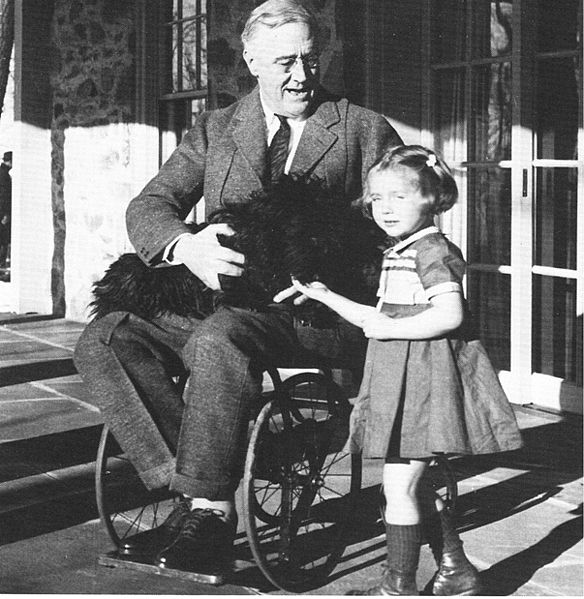
584px-RooseveltinwheelchairIt doesn’t take physical mobility to be able to move on in life. It takes determination and a realization that each day is important. Accepting what has happened in the past and knowing that there may be no tomorrow puts a proper perspective on the present. Like Lt. Col. Gadson, it is good to know that we are all traveling on a path of influence.

Other challenges of the past may include cruelty or abuse, a debilitating illness, a tragedy or any other circumstance that severely limits options. Perhaps our own bad choices caused pain and devastation to others as well as ourselves. Sometimes those memories overshadow everything else, even when circumstances have changed for the better.

How we deal with issues – pleasant or unpleasant – is a choice. We can actually get stuck on a point in our own time line – something in the past that stops us from moving on. When that happens, productivity in the present and subsequently in the future will be substantially curtailed. As has been proven by Lt. Col. Gadson and others, however, that does not need to be the case.

My husband says, “We are not promised tomorrow. We are promised eternity.” He is so right. God makes it clear at any moment we could be called upon to face Him. Tomorrow is uncertain. Eternity is promised to those who trust in Jesus.

...you do not know what will happen tomorrow. For what is your life? It is even a vapor that appears for a little time and then vanishes away…(James 4:14). “My sheep hear My voice, and I know them, and they follow Me. And I give them eternal life, and they shall never perish (John 10:27-28).

Therapeutic Writing

I enjoy writing. My self-imposed schedule of once a week articles, once a month devotionals, frequently updated Bible studies and always working on a book keeps my mind occupied. If and when adverse circumstances come along, I have discovered that because I have a writing schedule, I can keep thinking positively instead. Not all stress is bad. The tension that comes from having to write something at least once a week is a good thing.

120px-Computer_keyboardAs a result of this writing schedule, I view things a little differently than before. Even something trivial – a stepping stone, sunrise, walking through the woods or poison ivy (not so trivial when you have a reaction to it) or something more substantive like working with my husband on a project or becoming interested in Chinese New Year because I now have a granddaughter adopted from China – all these are potential subjects for articles.

I created a blog in order to interact with others, but the benefits I have received from being faithful in writing it have far exceeded even the potential of what it might do for anyone else. My blog is titled One Focus. It has done just that. It has kept my mind focused on what is really important.

SB19 (2)The fact that I am constantly thinking about something to write has saved me from other distracting thoughts. Each of us experiences self-talk – talking to ourselves in our minds. What dominates our thoughts eventually comes out in our actions. Choosing to think constructive thoughts will prevent the negative thoughts from crowding in.  Or so it has for me.

The beauty of writing a blog is that you can do it from practically anywhere. Even though I travel a great deal, my laptop is always with me. If I have an idea, I can start on a post even when the internet is not available. In fact, I seldom sit down and post in one sitting. I need to mull it over to make sure I am communicating what I really want to say.

I have come rather late to writing, blogging and maintaining websites. There is always something new to learn about putting your thoughts out there on the web. It is a wonderful medium, however, when used to help others.

Whether you share your thoughts with others or keep them to yourself, your thoughts define who you are. You are not the only one engaged in the conversation that goes on in your mind – God is as well.

And do not be conformed to this world, but be transformed by the renewing of your mind, so that you may prove what the will of God is, that which is good and acceptable and perfect…Finally, brethren, whatever is true, whatever is honorable, whatever is right, whatever is pure, whatever is lovely, whatever is of good repute, if there is any excellence and if anything worthy of praise, dwell on these things… for the righteous God tries the hearts and minds (Romans 12:2, Philippians 4:8, Psalm 7:9 NAS).

Background Software

Like practically everyone else, my life seems to be contained in my computer. I use it for work, reading, socializing, writing, shopping – you name it. I have stopped using my heavy dictionaries or encyclopedias. If I need to know something, I can search for it online.

I write a lot of Bible studies and often have a scripture in mind that I want to refer to. The problem is I can’t remember exactly where the scripture is located in the Bible – the chapter and verse. I used to use my concordance exclusively for this purpose. Now I google it.

Camera(132)Tied very closely to my use of information on the internet are the software programs on my laptop. Some programs I have chosen to install. Many of them are just necessary for the operation of my computer. What I am able to accomplish by using my computer are tied to software programs that run in the background. Being technologically challenged, these run in ways that are mysterious to me.

Even when I am unable to log on to the internet, my software programs enable me to keep working. Since I carry my laptop with me practically everywhere, I often even record reminder notes on my computer rather than using pad and pencil. The time saving possibilities are endless.

120px_Flickr___boellstiftung___Laptop_auf_dem_Scho_Since using my computer has become such a normal part of my life, I often forget the background software is there. I just take advantage of it and its functionality.

God created our brains to hold all the data we could possibly use. We load them with all kinds of information – some good, some bad. That “background software” can be useful or harmful, depending on how it is accessed.

Unlike computer software, data stored in our minds cannot be uninstalled. It can surface at any time. Satan can use the information for evil. God can remind us of something for usefulness. It is even possible to forget that we input something that will later be harmful or useful, so good judgment is called for when acquiring any new information.

Your word I have hidden in my heart, that I might not sin against You… Give instruction to a wise man, and he will be still wiser; teach a just man, and he will increase in learning… Wise people store up knowledge…For as he thinks in his heart, so is he…  (Psalm 119:11).

The Best Place to Stand

“Be still and know that I am God… And Moses said to the people, “Do not be afraid. Stand still, and see the salvation of the Lord” (Psalm 46:10, Exodus 14:13).

Not many of us are comfortable standing for very long, especially if it requires standing still. Observe people standing in line at a store waiting to pay for their purchases, looking for the shortest line and sometimes changing when one cashier is working slower than the others. Standing in a corner is punishment for some children.

In order to be productive (or feel productive), most of us think we need to be on the move. We leave little room in our lives for standing.

Interestingly, the English word stand is both a verb and a noun. The very fact that it has a verb form indicates that there is decisive action involved.

Among the definitions for the verb form of the word stand are:

  1. Have or maintain an upright position, supported by one’s feet: Sally stood in the center of the room
  2. Rise to one’s feet: they stood up when the king entered the room
  3. Move to and remain in a specified position: he stood aside to let them enter
  4. Be situated in a particular place or position: the courthouse stood in the middle of town
  5. Remain upright and entire rather than fall into ruin or be destroyed: only one house stood after the tornado came through the town
  6. Remain valid or unaltered: the decision stands
  7. Remain stationary: the train stood on track 2
  8. Remain on a specified course: the ship was standing south
  9. Adopt a particular attitude toward a matter or issue: the people took a stand on that issue

To stand is to take a position. It involves a choice. You can choose to move from a lying or sitting position to a standing position. You may also choose to stop moving in order to stand. The choices are not one-time choices, however. They are continual. You decide not only that you will stand, but you must also decide whether you will remain standing or fall back to the position you previously had.

Contrary to what seems to be true, standing can be hard work. Since it somewhat goes against our nature to stand, God has to continually instruct us to do so. He knows our tendency to move ahead of His plan for us.

Obviously, there is a time when we need to move on, but our reluctance to stand still can adversely affect our relationship with God. Until we learn to stand before Him, there are several things we may miss. The Bible describes in detail an upright man – who is a person who has learned to stand before God.

Stand before God to hear Him speak

Blessed is the man who walks not in the counsel for the ungodly, nor stands in the path of sinners…but his delight is in the law of the Lord (Psalm 1:1).

Moses knew the need to stand before the Lord. Moses instructed men inquiring about whether they could participate in the Passover after they had been come in contact with a human corpse to stand still while he asked the Lord about it (Numbers 9:8). While the people were to return to their tents, God told Moses to stand by Him to hear the commandments that God had for His people (Deuteronomy 5:31).

Stand before God to see Him work miracles

As we stand before the Lord, He works His miracles of nature. Samuel instructed the people to stand and see God work a miracle before their eyes (1 Samuel 12:16). As they stood before the Lord, He brought thunder and rain just as Samuel said He would. Elijah, on the other hand, told Ahab there would be no rain – not even dew – for years, except at his word because of the Lord God of Israel before whom he stood (1 Kings 17:1).

Stand before God to worship Him

Who may ascend into the hill of the Lord? Or who may stand in His holy place? He who has clean hands and a pure heart (Psalm 24:3-4a).

Part of the job of the Levites was to stand every morning and evening to thank the Lord and praise Him (1 Chronicles 23:30). Hezekiah, who opened the doors of the house of the Lord and repaired them, brought in the priests and Levites and instructed them to stand before God and serve Him (2 Chronicles 29:11).

Stand before God to let Him fight your battles

Jehoshaphat, being warned that a great multitude was coming to attack his people, sought the Lord. Through Jahaziel, God’s Spirit spoke to Jehoshaphat and the people. The battle was not theirs, but the Lord’s. They were not to worry. Their part was to stand still and see the salvation of the Lord (2 Chronicles 20:15-17).

When a Christian puts on the spiritual armor of God, the protection it provides allows him to stand and be victorious. Therefore take up the whole armor of God, that you may be able to withstand in the evil day, and having done all, to stand. Stand therefore, having girded your waist with truth, having put on the breastplate of righteousness, and having shod your feet with the preparation of the gospel of peace; above all , taking the shield of faith with which you will be able to quench all the fiery darts of the wicked one (Ephesians 6:13-16).        

Stand and Deliver, a movie produced in 1988, is on the American Film Institute’s list of 100 most inspiring movies. It tells the story of a California high school teacher who, determined to lead his students to a new level of accomplishment in math, did what others thought was impossible. He designed an intense math program for his students which required substantial sacrifice on his part as well as theirs. Not only did these troubled teens learn the basics of mathematics, but they mastered advanced algebra, math analysis and trigonometry in preparation for calculus in their senior year. Through all kinds of personal hardship, every student passed the AP calculus exam in their senior year only to have those results challenged by the Educational Training Service. Once again, their teacher came to their aid, getting the ETS to agree to let his students retake the test to overcome the implications of cheating.

Christians have a champion who is always on our side. He alone is in a position to obtain for us what would otherwise be impossible. His sacrifice enables us to stand the test of opposition and our own sinful nature. We can trust that if we stand righteous in the presence of the Lord through His Son Jesus Christ, He will deliver.

May 2012

© Stephanie B. Blake

Download The Best Place to Stand

Modern Devices and the Loss of Eye Contact

According to a 2011 New York Times article, there is an interesting trend among young people. If forced to make a choice teenagers would rather have the internet than a car. Staying connected to friends via a smart phone is a priority. “The iPhone is the Ford Mustang of today,” according to Thilo Koslowski, an automotive analyst. “Mobile devices, gadgets and the internet are becoming must-have lifestyle products that convey status.”

96px-Man_speaking_on_mobile_phoneWhat this study reveals confirms what I see on the streets. Everywhere I look someone either has his cell phone to his ear or is looking down at it. With their gaze fixed on their IPhone, they are checking social networks or looking for the nearest restaurant.

Recently a news report showed a man who nearly ran into a bear that had wandered into his neighborhood. The man did not see him until he nearly bumped into the bear. He had been texting on his cellphone.

I actually observed some teenagers in my church texting while they were sitting next to each other. I tapped them on the shoulder so they would stop. Some might consider me a spoilsport. I was listening to the sermon. Their texting was distracting.

Parents used to say, “Look at me when I am talking to you.” With smart phone usage so common, this is harder than it has ever been.

Before smart phones and the internet, people frequently stayed connected through personal visits – made possible by trips in those automobiles which are now rating second place among young people.

Technology has brought incredible advantages that make our lives easier. I make use of many of them. There is nothing wrong with email, texting or smart phones. I travel a great deal and keep up with family and friends through those means – especially SKYPE which gives me an opportunity to see as well as talk to my grandchildren. However, the trend away from eye contact and face to face conversation makes me uncomfortable.

Certainly there are many ways to communicate. Not all means have to be face to face to be productive. God has used many methods to get His message across to His people – angels, prophets, a burning bush and even a donkey.

There is nothing like eye contact and a personal encounter, however. God chose to meet us face to face through His Son, Jesus Christ. His eye contact was penetrating. So penetrating that people would rather avoid His gaze than be confronted with their own sinful nature. That’s what happened to Adam and Eve after they sinned. They hid.

Standing face to face with Jesus not only causes us to confront our own sin, but to realize that His deliberate personal participation in an imperfect world was to redeem those who would believe in Him. Those who have seen Him are never the same.

He is despised and rejected by men, a Man of sorrows and acquainted with grief and we hid, as it were, our faces from Him; He was despised and we did not esteem Him (Isaiah 53:3). But Peter said, “Man, I do not know what you are talking about.” And immediately while he was still speaking, a cock crowed. And the Lord turned and looked at Peter (Luke 22:60-61).

Marriage Partnerships

I am one of those lucky wives. My husband is the original handyman. He can fix just about anything and with a little self-education, he can build most anything he needs. Over the years he has saved us countless dollars because he is a do-it-yourselfer.

DSC06654We have a pretty good arrangement. I do what I can do. He does everything else. When he asks for my help on a project, I know it is not because he needs me. In fact, he says, “Just do your best and don’t worry about it if you mess up a little.” Actually, I mess up a lot but I am happy to work alongside him. I may not be much help, but I am very touched that he wants me to be there with him. The fact that he enjoys my company means more than anything.

I often think if I die first, he will have very little adjustment. If he goes first – well, not only will I miss him terribly – but I will have to hire plumbers, electricians, auto mechanics, call for outside tech support and much, much more. As I said, I am one of the lucky ones.

My husband is also a great gift giver. He often surprises me with something I never expected. He does things for me and gives things to me not because he has to. He wants to. Some things he does for me are fairly easy for him, like helping with the dishes. Other things may require a sacrifice on his part. He may purchase something for me that prevents him from having something he wanted. In each case, whether easy or sacrificial, what he does is an expression of love.

Our marriage is a partnership – albeit a little lopsided.

Jesus relates to His followers in a variety of ways. As our Savior, He redeems us. As the Bread of Life, He supplies our needs. As the Light of the World, He brings us out of darkness. As our Shepherd, He guides us. As our Rock, He gives us strength. As our Foundation, He gives us stability. As our Advocate, He intercedes on our behalf. As the Truth, He brings integrity and clarity to life. As the Word of God, He speaks to us. As the True Vine, He gives us the ability to bear fruit.

One of the incredible revelations about our relationship with Jesus is that He relates to us as our bridegroom. He calls the redeemed His bride. He is planning a wedding feast for us – the likes of which cannot be imagined.

Jesus asks for our participation in His work – not because He needs it, but because He wants it. I sometimes think I hear Him saying, “Just do your best. Don’t worry. I’ll take care of the results.”

He is the ultimate gift giver. Many gifts that He gives are easy for Him. Others cost him the ultimate sacrifice. In every case, what He does is an expression of the love of a bridegroom for His bride.

Husbands, love your wives, just as Christ also loved the church and gave Himself up for her that He might sanctify her, having cleansed her by the washing of water with the word…”Let us rejoice and be glad and give the glory to Him, for the marriage of the Lamb has come and His bride has made herself ready.” And it was given to her to clothe herself in fine linen, bright and clean, for the fine linen is the righteous acts of the saints (Ephesians 5:25-26, Revelation 19:7-8 NAS).

Obedience for our Own Good

One of the first words most children learn is “no.” Human nature resists rules. For his own good, however, parents need to set limits for their child. Playing in the fenced yard is OK. Playing in the street is not.

A parent’s responsibility is to help God mold the character of his child. A compassionate parent is also one that is in control. Even when a child does not yet understand the rules set by his parents (never touch a stovetop, don’t run with scissors), he should be confident there is good reason for them. A child should be able to trust his father to know what is best. Rules are boundaries for character development and protection.

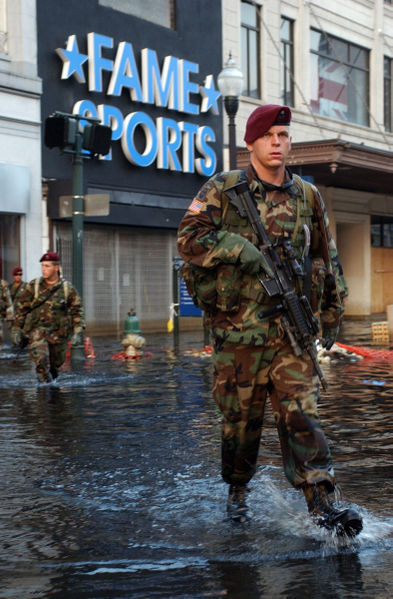
Hurricane KatrinaLaws in society are similarly put in place for protection. When they are no longer in place, human nature often takes over with disastrous results. The aftermath of Hurricane Katrina in New Orleans gave us a glimpse of what that was like.

Jesus is the only human being who obeyed His Father’s commandments completely. He willingly submitted Himself to our human limitations. As a Man, He learned obedience and set an example for us. His perfect life and sacrificial death released us from the bondage of the law. The law itself is good, but since we are incapable of obeying it perfectly, it was a bondage to us. Jesus’ gift of grace made reconciliation to God possible.

As Christians, we can trust God. We see in His laws His hand of guidance and protection. Jesus fulfilled the law for us and summarized all that it represented in His new commandment to love one another as He loves us. Believers are to be in submission, not under bondage. There is a difference. We are free in Christ. Submission is voluntary. Bondage is not.

We should look at the commandments of God like a child views the instruction of his parents. The boundaries and guidelines are for our protection and our growth.

“Do not think that I came to destroy the Law or the Prophets. I did not come to destroy but to fulfill” (Matthew 5:17). though He was a Son, yet He learned obedience by the things which He suffered (Hebrews 5:8). For to this you were called, because Christ also suffered for us, leaving us an example, that you should follow His steps (1 Peter 2:21).

Blinders and Staying on the Path

Occasionally I am in a country where horses and buggies or carts are still being used. In such cases, I notice the horses have blinders on. That is obviously to prevent them from being distracted and veering off the path the owner has chosen for them. It seems to work. The horses appear calm and relaxed both while walking and while waiting for further instructions.

I guess if all you can see is straight ahead of you, then that’s where you want to go. The horses have to trust their owners to keep them on a path with sure footing. Having blinders on lessens the possibility for the horse getting spooked. The blinders are most often used in public places where the horses could easily be scared by what is going around them.

112px-Horses_2Blinders prevent the horse from being confused. There may be several  choices – more than one path – in front of them. In order for the horse to know where the owner wants to go, he needs to see the path intended for him. Blinders are for the horse’s protection as well as direction of the owner.

Ordinarily, when you hear someone talk about a person having blinders on, it is meant in a negative sense. It usually means that someone does not recognize what is going on around him. He may refuse to accept what is happening. The origin of this idiom comes from the very thing I have observed in my travels – blinders on horses.

However, there is another way to think about blinders. If you are to intentionally stay focused on the path God has assigned for you, having blinders on can be a good thing.

Most of the horses wearing blinders have probably learned to trust their owners will lead them down a good road and know they will eventually settle in at night with nourishment and a place to sleep. As Christians, we may not need blinders, but the distractions of the world and our own desires can easily trip us up or lead us down the wrong path. We do need God to steer us in the right direction. We can totally trust Him to do so.

Let your eyes look straight ahead, and your eyelids look right before you. Ponder the path of your feet, and let all your ways be established. Do not turn to the right or to the left; remove your foot from evil (Proverbs 4:25-27).

The Rhythm of a Writing Style

Writing styles have certainly changed over time. Recently I reread the original Robinson Crusoe. I was shocked at how hard it was for me to get into the rhythm of Daniel DeFoe’s writing style. It was a bit like reading a legato book in a staccato world. His sentences are longer than my paragraphs.

I have several books on writing in my library. One of them, Write Tight: Say Exactly What You Mean with Precision and Power by William Brohaugh was highly recommended. I have found it to be quite useful.

Attention span is not what it used to be. In cultures where television is prevalent, people have become accustomed to finishing an entire story in thirty minutes. With the advance of technological devices such as laptops, IPads, IPhones etc., instantaneous information is the norm. I know few people who have patience for a slow internet connection. Practically everyone feels any price they have to pay for a fast connection is worth it.

The popularity of Twitter confirms this trend. 140 characters are enough to get your point across. Blogs longer than five hundred words are seldom read all the way through. Surveys indicate most people scan all online material instead of reading articles word for word.

In writing fiction, rambling dialogue is discouraged. Nonfiction writers are especially encouraged to write tight. You seldom need a “the” or a “that.” Say what you mean. Mean what you say. Say it concisely or don’t say it at all.

120px-Gutenberg_Bible,_Lenox_Copy,_New_York_Public_Library,_2009._Pic_01Writing styles also differ in translations of the Bible. I try to sample all translations and paraphrases. It occurs to me I don’t have a problem with lengthy sentence translations (such as the New King James). I suppose it is because, unlike novels like Robinson Crusoe, I often read from this version.

Some people stick with one translation and swear it is the only accurate translation there is. Funny thing, they seem to forget the original manuscripts were written in Hebrew, Aramaic and Greek. I only know one person who routinely reads from a Hebrew Bible. The rest of us have to rely on the translators to get the message across.

120px-Libri_booksI am grateful for those scholars who have given us various translations and even paraphrases. Occasionally I catch something in the NIV or NAS I missed in the NKJ. I sometimes enjoy a paraphrase in my devotional reading. For deep study, the multiple word equivalents to Hebrew and Greek words in the Amplified Bible prove to be very beneficial. With all the difficulties that occur with translating one language to another, God’s message comes through loud and clear to those who want to know Him.

All Scripture is inspired by God, and profitable for teaching, for reproof, for correction, for training in righteousness, so that the man of God may be adequate, equipped for every good work (2 Timothy 2:16-17).

The Life, Death and Resurrection of Christ: The Pivotal Point in History

Jesus said to her, “I am the resurrection and the life. He who believes in Me, though he may die, he shall live. And whoever lives and believes in Me shall never die. Do you believe this?” (John 11:25-26).

History is the story of God’s love expressed through His Son, Jesus Christ. It is really His Story. Everything preceding His arrival looks forward to it. Each event after His resurrection reflects back on His time on earth.

The Gregorian calendar: The most widely used calendar in the world today marks two periods of time: before Christ – B.C. – and Anno Domini (the year of our Lord) or A.D. The division may not be exactly the occasion of Christ’s birth (many scholars believe Jesus was born between 6 and 4 B.C.), but the intent is clear. The coming of Jesus Christ marked the most important event in history.

The Bible: The sixty-six books of the Bible are divided into two sections. The Old Testament chronicles the journeys of faithful men and women of God who looked for the Messiah. Many prophesied about that day.

The New Testament begins with the birth of Jesus, gives the story of His life, building His church, the activities of the first century church and promises His final appearance.

Of all the events in the life of Jesus that marked the fulfillment of the prophecies of the Old Testament that was fleshed out in His person in the New Testament, His resurrection is the culmination of all that had come before.

Easter: The resurrection of Jesus Christ marks the pivotal point in history where reconciliation between God and man became possible. His birth was miraculous. His life was pure and without sin. Jesus revealed God in the flesh. His death was the sacrifice for our sin. It was the resurrection that put the period on all that had come before. With the resurrection of Jesus, His mission was completed.

Jesus was always looking to the cross. Even when as a young boy of twelve He told His mother that He must be about His Father’s business, He knew that would lead Him to the cross. …looking unto Jesus, the author and finisher of our faith, who for the joy that was set before Him endured the cross…(Hebrews 12:2).

Mary and Joseph knew the prophecies about Jesus. The angel told Joseph that he was to call the child Jesus and that He would save His people from their sins. When Simeon saw Him in the temple when He was just a few days old, he warned Mary that her heart would be pierced. Although she and Joseph may not have known all the details of the horrors that lay ahead for Jesus, they were aware of how sin was paid for – a sacrifice. Even the wise man who brought myrrh as a gift to the Christ child knew that it was used for anointing the dead.

The Lord’s Supper: Just before His crucifixion, Jesus took His disciples aside and had a special supper with bread and wine: the bread symbolizing His body which He was about to offer as a sacrifice and the wine representing His shed blood. Christians around the world still practice this ordinance in memory of Him.

Lent: Observed by many worldwide, Lent is a forty day period leading up to Easter marked by self-denial and reflection on the sacrifice Christ made.

Many who observe Lent in the West start on Ash Wednesday. Those in the East often begin their observation on Clean Monday – the Monday before Ash Wednesday. Clean Monday is a reminder for them to begin the period of Lent with good intentions and a desire to clean their spiritual house. Even non-Christians are aware of pre-Lent festivals, such as Mardi Gras – also called Fat Tuesday – as times of feasting before Lent officially arrives.

According to the early church historian Eusebius, the earliest Christians fasted and prayed for one or two days, some for forty hours continually before Easter. When Eusebius’ History of the Church was translated from Greek into Latin, the translator put a punctuation mark between forty and hours, thus leading some people reading the document to believe that the fast was for 40-24 hour days instead of 40 hours. By 300 A.D., a 40-day celebration leading up to Easter was widespread.

Nevertheless, when Easter approaches, every Christian is reminded that Christ’s virgin birth, perfect life and love for mankind led Him to the cross. The cause for celebration is the resurrection. So they went out quickly from the tomb with fear and great joy, and ran to bring His disciples word. And as they went to tell His disciples, behold, Jesus met them, saying, “Rejoice!” (Matthew 28:8-9).

Without the first Easter – the resurrection – all of the prophecies, calendars and celebrations marking the coming of Christ would be meaningless. For it is with the resurrection that Jesus conquered the grave and defeated Satan. It is with the resurrection that He proved what He had been saying all along – that He is the Son of God. It is the resurrection that made it possible for us to live with Him eternally.

And if Christ is not risen, your faith is futile; you are still in your sins!…If in this life only we have hope in Christ, we are of all men the most pitiable. But now Christ is risen from the dead… (1 Corinthians 15:17,19,20).

© Stephanie B. Blake

April 2012

Download Easter is the Pivotal Point in History